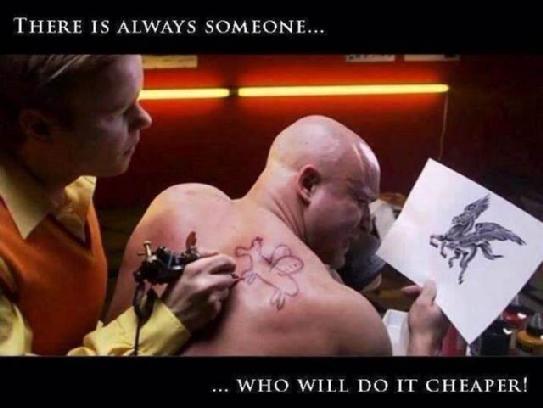
This is what happens when you do things on the cheap
Image
Reply

Looks good. I’m a huge Spidey fan
Amsterdam Has a Deal for Alcoholics: Work Paid in Beer
This is an amazing story and shows how incentives must align with behavior 🙂 While it is unconventional, it shows how creativity can really drive change.
This is really good video explanation of the dynamics at work in any economy. It is basic but good refresher for all of us
The Strategy That Will Fix Healthcare
Listen to this webinar where Michael Porter and Thomas Lee from Harvard discuss fixing healthcare. The key is focus on value and not cost or volume. The 6 strategies are:
1. Organize care into Integrated Practice Units focusing on primary medical conditions
2. Measure outcomes and cost for every patient
3. Move into bundled payments
4. Integrate care delivery systems
5. Expand geographic reach
6. Build an enabling information technology platform (wonder what this should be)
The Pace of Technology Adoption is Speeding Up
Very interesting article from Harvard Business Review on the accelerating pace of technology adoption. The obvious conclusion is we all need to be thinking about deploying technology that is open and agile as new technology is likely to dominate 2 years from now and what we use today will be different in the future.
 Most enterprises invest in front and back-office applications ignoring the middle office. Sales, service, finance, HR, and other organizations enjoy the latest systems from salesforce, SAP, etc. However, middle office processes like customer onboarding, out-of-the-lane support issue managment, transaction clearing, social media engagement, and vendor management often depend on email, spreadsheets, and old fashioned elbow grease.
Middle office processes are different at every company, but are critical for business success. One example is a large insurance company I work with. Once they sell a policy to a large business, they must manage the process of getting every employee an insurance card. In their case, they used to rely on email and manual processes to accomplish this task and their track record sucked (only 20% of the members had a card on the day coverage started). Once they invested in a system to orchestrate this middle office process, their success rate rocketed to the high nineties. This particular process has significant revenue and cost implications. On the revenue side, they achieve higher customer satisfaction when the policy starts and renewal rates subsequently increased. On the expense side, having a proper system to manage the process resulted in fewer penalties and required fewer resources to accomplish. There are middle office processes in every company.
The irony is many of these middle office processes don’t require a huge investment in business process management or other expensive systems. Simple workflow, collaboration, and reporting are usually sufficient for most processes falling into this area. They require attention and limited investment to improve. Depending on the company and gap size between the front and back-office, improving the middle office can dramatically improve overall performance by shrinking or eliminating the gap.
Here are a couple of podcasts I highly recommend and one article worth reading.
The End of Customer Service Heroes. This is an interview with Frances Frei and Anne Morriss, authors of Uncommon Service: How to Win by Putting Customers at the Core of Your Business. It was very provocative and interesting. I bought the book and will review it.
Save Me From Myself. This is a Freakonomics podcast that are always interesting. The episode is about commitment devices or ways people use to change. One idea Levitt suggests to stop eating is tie a small jar of vomit around your neck and take a whiff when you get hungry. Gross but no doubt effective.
Pasta, Not Bacon, Makes You Fat. This is a graphic from The Big Picture Blog on how the body digests carbs and why they make you fat and how fat isn’t the culprit. Very interesting.
 Checklists started by making risky situations like landing planes and surgical operations safer. These activities are performed by expert pilots and surgeons, who have practiced them thousands of times. However, the brain can only remember so much, especially in the midst of stressful situations. Doing something over and over again also creates a false sense of confidence and can lull an expert into skipping important steps or cutting corners. After reading an excellent book called The Checklist Manifesto: How To Get Things Done Right by Atul Gawande, I think we should be using checklists in many business process besides the most dangerous ones.
Gawande explains in his book that checklists hit the scene in the 1930s when a group of test pilots came up with the first one after seeing a friend stall and crash a plane during a test flight. The accident investigation revealed that with the “newer” planes, there were too many things for one man to track including “four engines, each with its own oil-fuel mix, the retractable landing gear, the wing flaps, etc.” Planes have obviously become increasingly more complex and now checklists are built into the process of operating advanced aircraft. Operating on human beings is the same when you consider pre-op, anesthesia, patient history, allergies, post-op, etc. where checklists have demonstrated measurable improvements in outcomes. It stands to reason that business users performing processes like sales, accounting, customer support, marketing, etc. could similarly benefit from using checklists.
You can find relatives of checklists in the business world today. Call scripting for service center agents is a popular use case. The agents use on-line wizards to walk through a process like an RMA or some other transaction. The list may not tell the agent every word he or she must say but it should guide the high level steps they take. We have a sales checklist at salesforce to review when we move an opportunity from one stage to the next. It reminds us to check if we have an ROI study completed, budget confirmation, etc. The checklist doesn’t tell someone how to do their job or provide a detailed recipe for everything under the sun. Its purpose is to focus on the 5 to 7 important things that make or break a process. Checklists can also simplify complex processes into bite-sized chunks that can be consumed as a process unfolds. A customer on-boarding checklist is a great example. Anytime a new customer joins a company, there could be a shared checklist among sales and service to guarantee the important steps like gathering accurate information, guiding service provisioning, distributing member cards, etc. are addressed.
Putting a checklist to use doesn’t necessarily require fancy technology. Before airplanes went fully electronic, checklists were in binders next to the pilot’s seats. Spreadsheets, memory tools like Evernote and other systems can manage a checklist. The important thing is the list represents what is most important, it is built as a team, and can evolve as the business changes. Where could you use a checklist in your business or personal life?
 Working at salesforce makes it easy to get caught up in the hype around social enterprise; the vision is compelling. At some point, every vendor will take up this mantra, using different words, and the volume will eventually die down. Looking beyond the hype, one aspect of the social enterprise that is tangible, real, valuable (insert other awesome words here) is working with other people in the context of business process.
Most company processes involve some combination of
A social process involves taking steps 2 through 4 and inserting them into step 1 where everything happens in one place. Whether it is one single system or systems stitched together, putting the business process data and the people who process it together is a real way to improve productivity and quality. The beneifts include:
Three years from now, this will be standard procedure and we will look on anything that requires more than one system plus email and say “this sucks”.
 Business Common Sense